
What My Father Handed Down
By Susan Weingartner
My father would have been 90 today.
He was a wealth advisor for 33 years, and he worked relentlessly. As a little girl, I remember often wandering into his office. It was a cross between a library and a mad scientist’s laboratory. Books were stacked high on the shelves. Papers were everywhere. It was messy, serious, and entirely his.
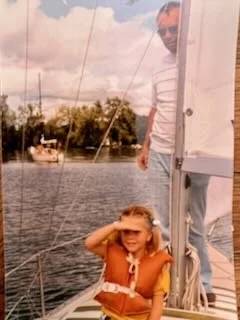
When I graduated from college with a degree in psychology, he asked me to join his practice.
I said no.
“Dad, if I’m going to work more than 40 hours a week, I better love what I do, and I better be making the world a better place.”
At the time, I couldn’t see how working in wealth management would allow me to do either. It has taken me decades to understand that while my father and I took different career paths, underneath both were many of the same questions about purpose, responsibility, and what gets carried forward. We just never created the space to understand each other’s point of view.
My father was diagnosed with pancreatic cancer on his birthday in 2022 and passed away six weeks later. In those final two weeks, we didn’t talk about investments. We shared memories. We told each other how much we loved one another. And my father had the opportunity to share one of his deepest regrets: working relentlessly meant he hadn’t been as engaged with us as he wished.
Looking back, I realize that the greatest legacy my father handed down had nothing to do with money. It was his deep integrity. It was the seriousness with which he carried responsibility.
I wish we had talked more about what he hoped I would carry forward. I wish I had understood what he was offering when he invited me into his work. And I wish he could see that I found my way back, just in a different seat.
I wonder how often this happens in families. A parent believes they are offering an opportunity. A son or daughter experiences it as an expectation, or perhaps as a life that doesn’t belong to them. Both care deeply. And yet, without the deeper conversation, we can miss what the other is trying to say.
Most families prepare the capital.
But preparing the people requires a different kind of conversation. It asks us to name what matters, what is expected, and what we hope will endure long after we are gone.
Today, I’ll be thinking about my father, the legacy he left me, and the conversations I wish we had made time for.
A question to sit with…
What has someone handed down to you that you are only now beginning to understand?
If someone came to mind, perhaps this is a conversation worth having while there is still time.
